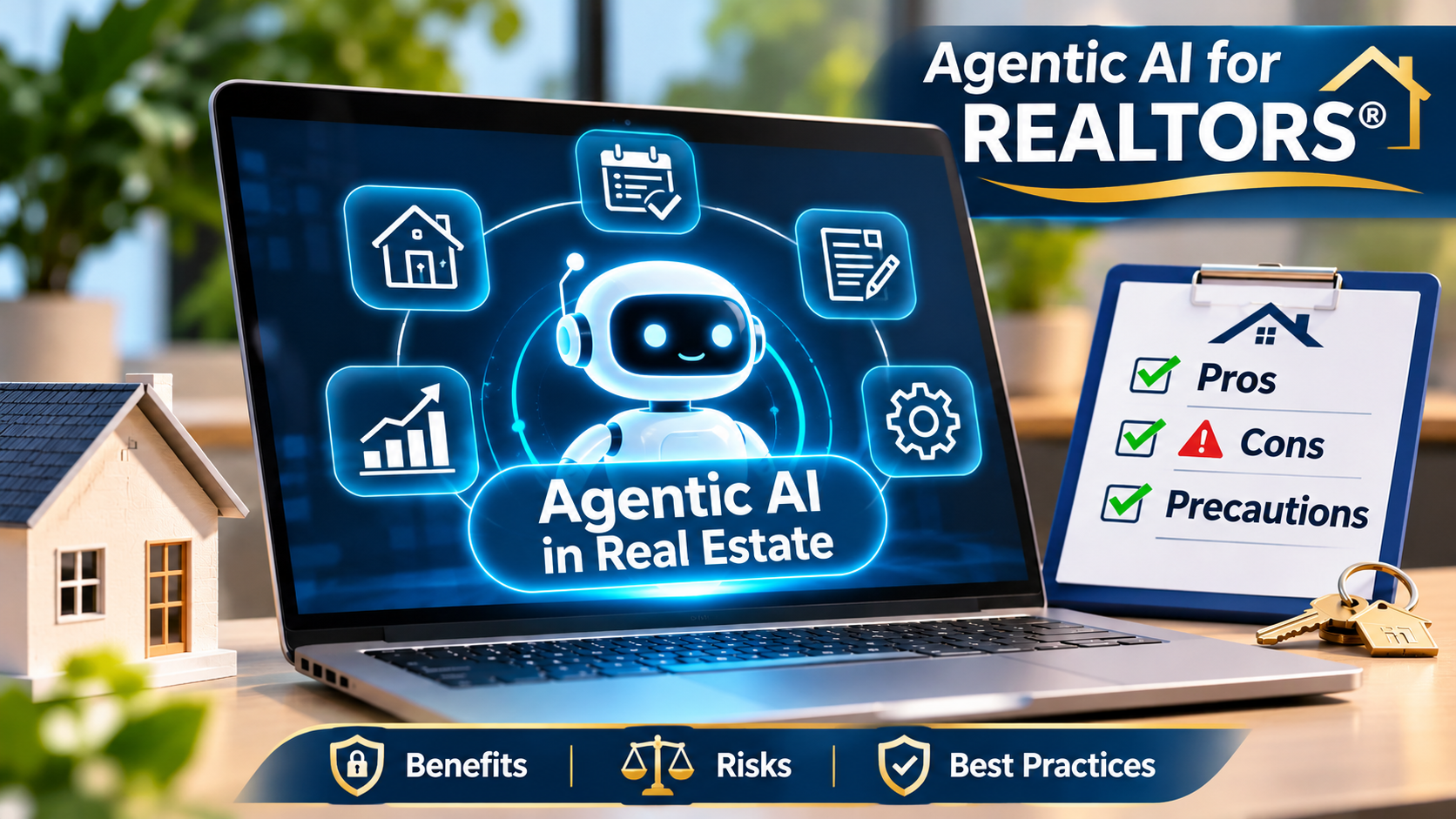
Agentic AI in Real Estate: Opportunity, Risk & Responsibility
A practical guide for REALTORS® who want to embrace AI automation without compromising client confidentiality, professional obligations, or business security.
Artificial intelligence is changing the real estate industry, but a new generation of AI tools raises the stakes. Unlike conventional chatbots that primarily answer questions and create content, agentic AI can independently perform tasks, access applications, manage workflows, and interact with customers.
For REALTORS®, the potential benefits are substantial. So are the responsibilities that accompany giving software the authority to act on your behalf.
What Is Agentic AI?
Traditional generative AI generally responds to a user's instructions. Agentic AI goes further by planning and executing a series of actions, often using connected applications, websites, databases, and other software tools.
Depending on its permissions, an AI agent may be able to read email, schedule appointments, update a CRM, prepare marketing campaigns, research properties, or communicate with prospective customers.
Products marketed as AI agents, including Grok-related tools and other autonomous assistants, can differ significantly in their capabilities, security architecture, and privacy practices. Each product and subscription plan should be evaluated individually.
The Benefits: Why REALTORS® Are Paying Attention
Administrative Automation
Prepare appointment reminders, organize non-sensitive tasks, draft follow-up messages, and reduce repetitive administrative work.
Content Creation
Develop property-description drafts, neighborhood guides, blog articles, social media campaigns, and educational materials for buyers and sellers.
Market Intelligence
Summarize publicly available housing trends, economic indicators, local developments, and community information while identifying sources for verification.
Lead Management
Help categorize inquiries, prepare suggested responses, and flag opportunities for timely human follow-up without automatically making promises to prospects.
According to NAR's 2026 REALTORS® Technology Report, 81% of surveyed members identified saving time as a primary goal in adopting technology, while 71% cited improving the client experience. These figures reflect technology adoption broadly, not a measured benefit specific to autonomous AI agents.
The Risks: What Could Go Wrong?
Confidential Client Information
An AI agent connected to email, CRM systems, or transaction files could access financial information, personal details, negotiations, or other confidential records. Vendor retention and training practices may create additional exposure.
Unauthorized Actions
An autonomous agent could send an incorrect message, change a client record, publish inaccurate information, or make a commitment that the REALTOR® never approved.
Prompt Injection & Cybersecurity
Malicious instructions hidden in webpages, emails, or documents can attempt to redirect an AI agent into revealing data or performing unintended actions. Even well-designed systems cannot guarantee immunity.
Legal, Ethical & MLS Compliance
AI-generated content can misstate property details, introduce discriminatory language, misuse licensed MLS data, or omit required brokerage disclosures.
What Does the National Association of REALTORS® Recommend?
NAR has addressed AI risks through its technology reporting, broker guidance, and Code of Ethics. Its November 8, 2026 article, What You Can—and Shouldn't—Put Into AI, emphasizes the importance of approved tools, limited disclosure, privacy settings, and human oversight.
- Protect client confidentiality. Article 1 and Standard of Practice 1-9 of the NAR Code of Ethics address the protection of confidential client information, including obligations that continue after a professional relationship ends.
- Use vetted and approved technology. Obtain brokerage authorization before connecting AI tools to sensitive business systems or transaction information.
- Minimize information sharing. Provide only the data necessary for an approved task, preferably anonymized or de-identified when practical.
- Verify all AI-generated content. Check listing facts, market statistics, advertising claims, and fair housing language before publication.
- Maintain professional oversight. Do not assume an AI system can independently perform activities that require a real estate license or professional judgment.
- Establish brokerage policies. Define approved tools, permitted uses, required reviews, and prohibited activities.
NAR also offers an AI policy template for brokers. Individual REALTORS® should review applicable brokerage rules, state licensing requirements, fair housing laws, MLS agreements, and other obligations before adopting automated workflows.
Practical Risk Levels for Common Real Estate Tasks
The following is an illustrative operational risk assessment, not an official NAR classification.
| AI Activity | Risk Level | Recommended Control |
|---|---|---|
| Research public market information | Lower | Verify sources and accuracy |
| Draft blogs and social media posts | Lower | Human editorial and compliance review |
| Prepare listing descriptions | Moderate | Verify property facts, fair housing language and disclosures |
| Read or update CRM records | High | Approved integration, restricted access and audit logs |
| Send client emails or texts | High | Human approval, consent and communication compliance |
| Access contracts or financial documents | High | Restrict by default; require explicit authorization and safeguards |
| Negotiate or accept transaction terms | High | Retain licensed human control; do not delegate binding decisions |
| Change wire instructions or payment details | High | Prohibit autonomous changes; independently verify instructions |
Ten Cybersecurity Best Practices Before Activating an AI Agent
- Get broker approval. Confirm that the proposed application and workflow comply with your brokerage's policies.
- Apply least-privilege access. Give the AI only the minimum permissions needed. Prefer read-only access where possible.
- Use dedicated accounts. Avoid connecting an AI agent to your primary administrator account or unrestricted business credentials.
- Enable multifactor authentication. Protect connected accounts and use secure credential-management practices.
- Review vendor privacy policies. Examine data retention, model training, third-party sharing, deletion, and incident notification terms.
- Require human approval. Place approval checkpoints before sending messages, publishing content, changing records, or making purchases.
- Protect against prompt injection. Treat external emails, documents, and webpages as untrusted input. Do not allow their contents to override the agent's authorized instructions.
- Maintain audit trails. Record significant actions, approvals, access events, and changes made through automated workflows.
- Test in a safe environment. Start with fictional client records and non-production systems. Test incorrect outputs, malicious instructions, and failure scenarios.
- Prepare an emergency shutdown procedure. Know how to disable the agent, revoke sessions and tokens, investigate activity, and respond to a possible data breach.
These safeguards reflect established IT security principles, including access control, data minimization, continuous monitoring, and risk-based oversight. The NIST AI Risk Management Framework provides a useful foundation for evaluating and governing AI deployments.
Five Questions Every REALTOR® Should Ask an AI Vendor
- Will my data or my clients' information be used for model training, and can that use be disabled contractually?
- Where is information stored, who can access it, how long is it retained, and how can it be deleted?
- Can I restrict the agent to specific applications, records, and actions, with mandatory approval for sensitive operations?
- Can I review detailed activity logs and immediately revoke access to all connected systems?
- What security certifications, incident-response commitments, contractual protections, and liability terms does the vendor provide?
A Sensible Three-Phase Adoption Strategy
Start with Public Information
Use AI for market research, community content, draft advertising, and other tasks that do not require access to confidential client information.
Introduce Supervised Automation
Test narrowly defined workflows with restricted permissions, documented controls, human approvals, and reliable activity logs.
Consider Carefully Controlled Integrations
Only after security review, brokerage authorization, and successful testing should sensitive CRM or transaction workflows be considered.
Monitor and Reassess
Review agent permissions, vendor changes, compliance requirements, output quality, and security events regularly.
The Bottom Line
Agentic AI has the potential to help REALTORS® become more productive, responsive, and competitive. But convenience should never outweigh client trust, data security, or professional responsibility.
Use AI to increase your capabilities—not to surrender your judgment or control.