Are You Safe from Electricity Inflation?
Across the country, Americans are hearing more about electrical grid strain, AI-driven data center growth, and rising utility costs. Technology companies, server farm operators, and utility providers continue to reassure consumers that power supplies are stable and pricing is under control.
But real-world evidence suggests the pressure on electricity pricing is already showing up in many regions. According to Forbes, wholesale electricity prices near major data centers have risen sharply in recent years, and those higher costs can be passed on to customers. The Financial Times has also reported statements attributed to Amazon employees indicating that power demands from Amazon Web Services (AWS) have strained local grids in certain areas.
Even if you don’t live near a major data center, the power grid is interconnected. Utilities buy and sell electricity across regions, and higher demand in one area can create pricing pressure elsewhere. That’s how “the grid” works—and why many consumers are beginning to research not just potential increases, but the increases that have already happened.
How big of a deal is utility inflation?
Here is the pattern of increases from Tucson Electric Power (TEP):
- 20-Year Annual Average Increase: 2.5%
- 15-Year Annual Average Increase: 3.4%
- 10-Year Annual Average Increase: 4.2%
- 2020–2023 Average Increase: 24.9%
- 2026 Rate Increase Request: 14.0%
If you’ve ever seen a compounding interest chart, it can be a startling experience. The same principle applies to inflation. Even a “moderate” average increase like 4.2% compounded over decades can dramatically change household budgets.
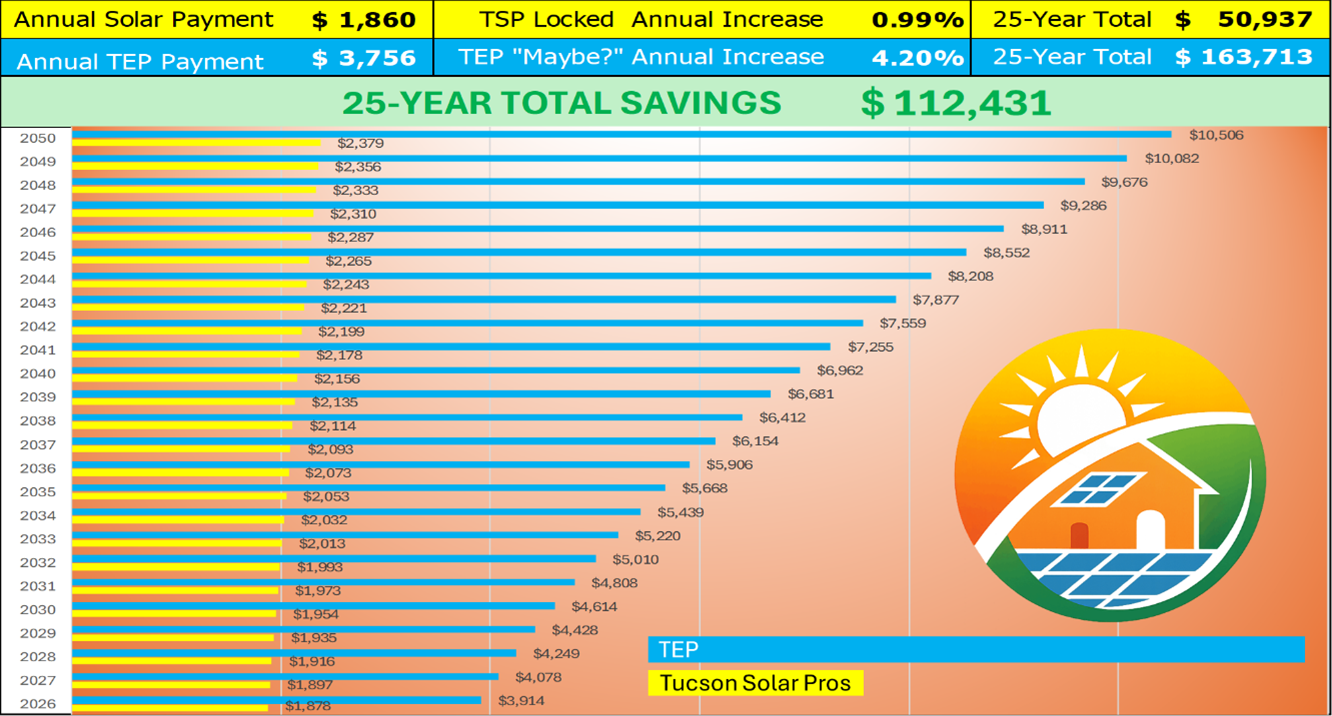
For example, an annual power bill of $3,756 can grow to roughly $10,506 over 25 years at a 4.2% average annual increase. Over 25 years, that can total approximately $163,713 in electricity costs.
Solar can help—but which path is best?
1) RENTING ELECTRICITY (No Solar)
Staying utility-only is like renting a car: you pay month after month, but you don’t build equity or gain long-term pricing control. You receive electricity, but you remain exposed to future rate increases.
2) BUYING CASH (Solar Option)
Buying a solar system outright can eliminate financing costs, but many homeowners don’t have the cash required. And in some cases, the time value of money can make paying cash less financially attractive than other approaches.
3) BUYING WITH A LOAN (Solar Option)
Financing spreads the cost over time, but the economics can vary. In many structures, corporate system owners may benefit from federal incentives that individual homeowners don’t capture in the same way. Interest costs can also raise the total price paid over the long run.
4) LEASING (Often the “Sweet Spot”)
In many solar lease structures, the leasing company purchases the system and may qualify for federal incentives, then leases the equipment to the homeowner—often offering zero-down options. Many leases are structured with minimal annual increases (commonly in the 0%–2% range, often around 1%).
When a homeowner leases a properly sized solar setup designed around their usage, monthly energy costs can become more predictable. In many cases, the system can generate enough electricity that utility “buy-back” or credit programs substantially offset the remaining monthly utility charges.
An Example Case
- 2025 average monthly electric bill: $313
- Solar lease payment (zero-down; ~0.99% annual increase): $155
Importantly, that solar payment is not intended to be “in addition to” the old electric bill. A properly designed system typically offsets most (and sometimes virtually all) of the monthly utility bill, depending on the rate plan and credit structure.
Over 25 years, the projected difference between “renting” power from the utility versus stabilizing costs through solar leasing can be substantial—on the order of $112,000 in this example.
What if you invested the difference?
Some homeowners compare this to the old financial planning concept: “Buy term and invest the difference.” If a household saved that difference and invested it over 25 years, the long-term impact could be significant. At a hypothetical 12% average annual return, the future value could approach half a million dollars.
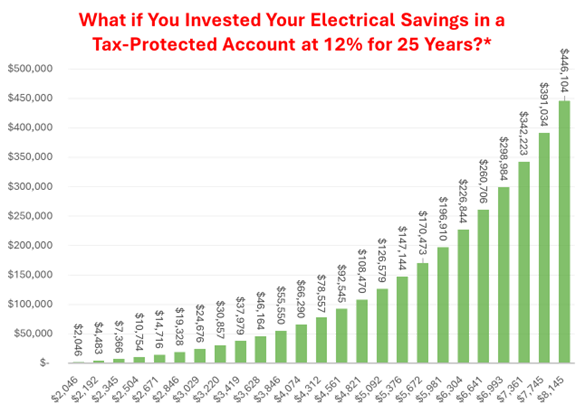
That’s one way to think about long-term inflation protection: instead of compounding utility costs working against you, predictable energy costs can help you redirect dollars toward savings or investment.
Rick Sailors is a Solar Energy Consultant with Tucson Solar Pros
If your business serves homeowners and you would like to reach residents across hundreds (and growing) of city and neighborhood pages, learn more about local advertising opportunities at ConnectNeighbors.com.
Contact Us

Browse local businesses by category.