Election Analysis | November 9, 2026
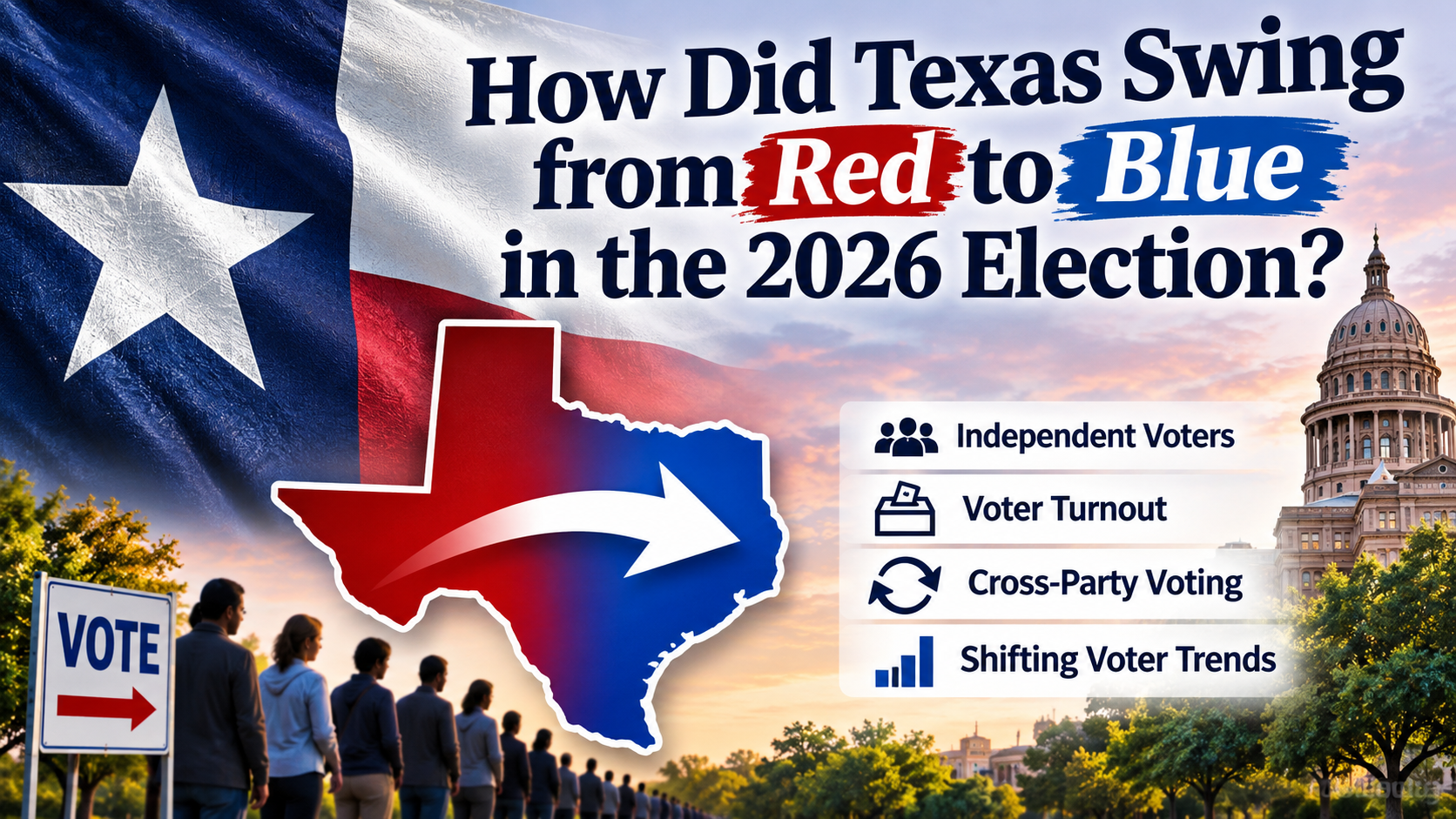
How Did Texas Swing from Red to Blue in the 2026 Election?
A closer look at independent voters, changing political loyalties, voter turnout, and the surprising results of the November 3 election.
For decades, Texas has been considered one of the most reliable Republican states in America. In November 2024, Donald Trump carried Texas by approximately 14 percentage points. Just two years later, on November 3, 2026, Texas voters elected Democrats to the governor's office, the U.S. Senate, and numerous other statewide positions.
How could a state that voted so decisively Republican in one election produce such dramatically different results just two years later?
The answer is more complicated than simply saying Texas voters became Democrats. The results point to a combination of independent voters, changing candidate preferences, differences in turnout, and dissatisfaction with economic and political conditions.
1. The Election Results: A Historic Political Shift
U.S. SENATE
55.1%
James Talarico (D)
Ken Paxton (R): 43.0%
GOVERNOR
52.8%
Gina Hinojosa (D)
Greg Abbott (R): 45.7%
Approximate shares from unofficial post-election returns; final certified totals may differ.
Talarico became the first Democrat elected to the U.S. Senate from Texas since 1988. Hinojosa became the first Democrat elected governor since Ann Richards in 1990, as well as the state's first Latina governor.
Democrats also captured other statewide offices and control of the Texas House of Representatives. This was not simply an isolated victory in one competitive race.
2. Independent Voters: A Critical Part of the Explanation
One of the most important groups in any competitive election consists of voters who do not consistently identify with either major political party.
Texas has an unusual voter registration system. Texans do not register as Republicans, Democrats, or independents. Party affiliation can arise through participation in party primaries or other formal activities, but voter registration itself does not establish a permanent political party designation.
Consequently, election officials cannot simply count registered independents and determine how they voted. Understanding these voters requires surveys, exit polling, and statistical analysis.
What did polling reveal?
An October 2026 University of Texas/Texas Politics Project poll found that self-identified independents without a partisan leaning preferred Talarico over Paxton by 69% to 11%.
Independent Voter Preferences — October 2026 Poll
■ Talarico (D) ■ Paxton (R) ■ Other / undecided
University of Texas poll, September 25–October 5, 2026. Independents without a partisan leaning were a small subgroup of the likely-voter sample; results should be interpreted cautiously.
This suggests that voters outside the traditional Republican and Democratic bases played an important role. However, not every independent voter supported Democrats, and a pre-election poll is not a substitute for the final vote.
3. Some 2024 Trump Voters Supported Democrats in 2026
Perhaps the most revealing finding is that some Texans who supported Donald Trump in 2024 voted for Democratic candidates in 2026.
An analysis of 2026 exit-poll responses estimated the following voting patterns in the U.S. Senate race:
| 2024 Voting History | Talarico (D) | Paxton (R) |
|---|---|---|
| Voted for Trump | 11% | 86% |
| Voted for Harris | 98% | 1% |
| Voted third-party | 74% | 16% |
| Did not vote in 2024 | 81% | 16% |
Estimates based on reported 2024 voting behavior in 2026 exit polling. Percentages do not necessarily total 100% because of other responses. These are survey estimates rather than verified individual voting records.
The analysis estimated that approximately 519,000 people who voted for Trump in 2024 supported Talarico in 2026. It also estimated that approximately 650,000 Talarico voters had not participated in the 2024 election.
These estimates illustrate two distinct forces: voters changing their candidate preference and voters entering the electorate after sitting out the previous election.
Voting for a Democrat in one election does not necessarily mean a voter has abandoned conservative principles or permanently changed political allegiance. Voters may distinguish between individual candidates, policies, and the political circumstances of a particular election.
4. Turnout: Who Showed Up and Who Stayed Home?
Election results are determined not only by how people vote, but also by which people participate.
Approximately 9.8 million Texans voted in the 2026 general election, a record for a Texas midterm election. Yet participation was not evenly distributed geographically or politically.
Urban, suburban, and competitive counties experienced strong participation. In heavily Republican rural areas, turnout generally did not keep pace with the relative participation seen in more Democratic areas.
Consider a simplified example:
Illustrative Example — Not Actual Election Totals
Suppose a Republican candidate previously received 600,000 votes and a Democrat received 400,000 votes.
In the next election, Republican turnout falls to 500,000 votes while Democratic turnout rises to 550,000.
The Democrat wins without requiring every previous Republican voter to change their political preference.
In Texas, the actual result appears to have involved both turnout differences and some voters changing candidates. Neither explanation alone tells the complete story.
5. The Geography of the Political Shift
Texas is politically diverse. The Dallas–Fort Worth metropolitan area, Houston, Austin, rural West Texas, and the Rio Grande Valley have very different demographic, economic, and political characteristics.
Suburban Texas
Counties such as Tarrant and Collin experienced substantial movement toward Democratic candidates compared with the 2024 presidential election. Suburban voters are particularly important because of their large populations and their mixture of conservative, moderate, and independent political preferences.
Major Urban Counties
Harris County, which includes much of Houston, and Dallas County provided large Democratic vote totals. Greater Democratic margins in populous counties can outweigh Republican victories across numerous smaller rural counties.
South Texas and the Rio Grande Valley
South Texas is especially noteworthy. Donald Trump made substantial gains among Hispanic voters in 2024 and carried numerous border counties. In 2026, Democrats recovered significant ground in the region.
Economic concerns, immigration policy, and candidate appeal were among the issues identified in reporting on Hispanic voting patterns. However, Hispanic voters are not politically uniform, and their preferences cannot be reduced to any single issue.
A county moving toward Democrats does not prove that every individual voter changed political allegiance. Changes in turnout and the composition of the electorate also affect county-level margins.
6. Candidate Appeal and Political Issues Also Matter
The 2026 election occurred during a period when voters were expressing concerns about affordability, the cost of living, public education, immigration, and political leadership.
Democratic candidates emphasized economic issues and government accountability. Republican candidates emphasized conservative policies, immigration enforcement, and their concerns about the direction Democrats would take the state.
Different voters weighed these issues differently. Some may have supported Democrats because of economic concerns. Others may have been dissatisfied with specific Republican candidates, while some continued to support Republicans because of their policy positions.
The Senate and governor's races also produced different Democratic victory margins. That difference reinforces the importance of candidate-specific considerations rather than assuming every voter made an identical party-based decision.
7. Has Texas Permanently Become a Blue State?
The November 2026 results establish that Democrats can win statewide elections in Texas, even after years of Republican dominance.
They do not establish that every Texan who voted Democratic in 2026 will continue voting Democratic in future elections.
Several questions remain:
- Will independent voters maintain their 2026 candidate preferences?
- Will voters who crossed party lines return to their previous choices?
- Will the turnout differences seen in 2026 continue in future elections?
- Will voters judge future candidates differently based on economic conditions and public policy?
- Will Texas exhibit similar voting patterns during the next presidential election?
These questions cannot be answered definitively from one election. Future results and additional voter research will be needed to distinguish a lasting political realignment from an election-specific change.
The Bottom Line
Texas did not swing from red to blue for just one reason.
The evidence points to a combination of independent voters favoring Democratic candidates, some previous Republican voters crossing party lines, previously inactive voters participating, and turnout differences across the state.
Perhaps the most important lesson is that party loyalty and voting behavior are not always the same thing.
A state can have a substantial conservative electorate and still elect Democrats when enough voters make different choices about candidates, policies, and participation. Texas's 2026 election illustrates just how significant those differences can be.
Sources and Further Reading
- The Texas Tribune — 2026 General Election Results
- The Texas Tribune — James Talarico Defeats Ken Paxton
- University of Texas — October 2026 Political Poll
- Houston Chronicle — How Republicans Lost Texas, in Three Maps
- Texas Election Tracker — Exit-Poll and Voting-Shift Analysis
- Texas Secretary of State — Party Affiliation Rules
Editorial note: This article examines the November 3, 2026 election using available election returns, polling, and published reporting. Vote totals may be revised during certification. Survey-based estimates describe voting patterns and should not be interpreted as verified individual voting histories.